On Thursday, Ethereum (ETH) experienced a significant decline, momentarily trading below the $2,000 mark for the first time since late March. This downturn effectively wiped out all gains achieved in the second quarter (Q2). Currently, ETH is down 19% from its peak of nearly $2,500 observed in April.
Over the course of this week alone, the altcoin has lost approximately 6% of its value.
If Ethereum fails to hold the crucial Q2 support level at $2,000, short-sellers may drive its price down to around $1,800—a significant low within the 2026 sideways trading structure.
This pullback reflects a broader macroeconomic correction that has also pressured Bitcoin. However, analysts from Nansen suggest that Ethereum’s current weakness indicates a “deeper problem.”

Underlying Issues: ETF Outflows and Decreased Network Activity
Nicolai Sondergaard, an analyst from Nansen Research, provided insights, noting that
Gas fees are currently hovering below 2 gwei, very close to cycle lows, indicating weak network demand. A decline in transactions and contract engagements has resulted in a slowdown of Ethereum’s burn mechanism, diminishing its previously deflationary nature.
At present, Ethereum is struggling to maintain its “store of value” narrative. In response to the ongoing inflationary pressure decreasing the asset’s value, Grayscale has proposed limiting staking rewards.
Part of the issue stems from structural changes, as most transactions are now processed through Layer 2 solutions (L2s), diverting revenue away from Ethereum’s mainnet, according to Sondergaard.
He further emphasized that the low burn rate has transitioned ETH into an inflationary asset, effectively removing a critical narrative that supported investor confidence in previous cycles.
Concerning institutional interest, Ethereum has been lagging behind Bitcoin in 2026. Notably, the ETH/BTC ratio has now dropped to a year-low. Sondergaard pointed out,
The ETH/BTC ratio compresses to 0.027, which serves as an important indicator. Bitcoin continues to dominate institutional interest, while Ethereum has yet to match that appeal.

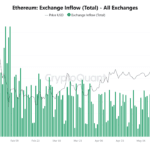
Since May 11, Spot ETH ETFs in the U.S. have experienced consistent daily outflows, totaling a remarkable $522 million for the month—the highest since December.
Triggers for Potential ETH Recovery
For Ethereum to initiate a strong recovery, it will require renewed inflows from Spot ETH ETFs and enhanced network activity. Sondergaard from Nansen concluded,
The macroeconomic landscape also needs to stop constraining risk appetite. Ethereum does not need to see all of these factors turn around at once, but two would be a good start. Presently, it holds none.
Interestingly, whales have been active in accumulating during this recent dip. Wallets containing over 100,000 ETH now account for 22% of total supply, or 17.4 million ETH, representing a ten-week high.

Despite whale demand, driven largely by major players like Bitmine, the inflow of capital has not sufficiently reversed the trend. ETH’s capital outflows have worsened since last October, as reflected in the Realized Cap data.
Since the start of 2026, the altcoin has seen an astonishing $15 billion in capital outflows, with its Realized Cap diminishing from $310 billion to $295 billion.
These numbers highlight the negative aggregate demand for ETH, reinforcing Sondergaard’s analysis.

Will Ethereum Price Hit $1.8K Again?
Should the prevailing weak demand and capital outflows persist, it is plausible that Ethereum’s price may retreat to the $1,800 level. Interestingly, the MVRV Pricing Bands suggest a potential retest of this support.
Following a rejection near the Realized Price (1.0 RP, green) at $2,300 earlier this year, ETH appears likely to touch the next support band around $1,800 (blue). Historically, during the 2022 crypto winter, Ethereum only confirmed a true bottom after surpassing the lower bands of this metric.

In conclusion, if the poor institutional demand and decreased network activity persist into June, Ethereum’s price could potentially aim for the $1,800 mark in the medium term.
Conclusion
- As per Nansen, Ethereum currently lacks the crucial catalysts that once fueled its past rallies.
- Whale investors holding over 100,000 ETH are actively purchasing during this dip, increasing their total holdings to an impressive 17.4 million coins.