Write a new detailed article from 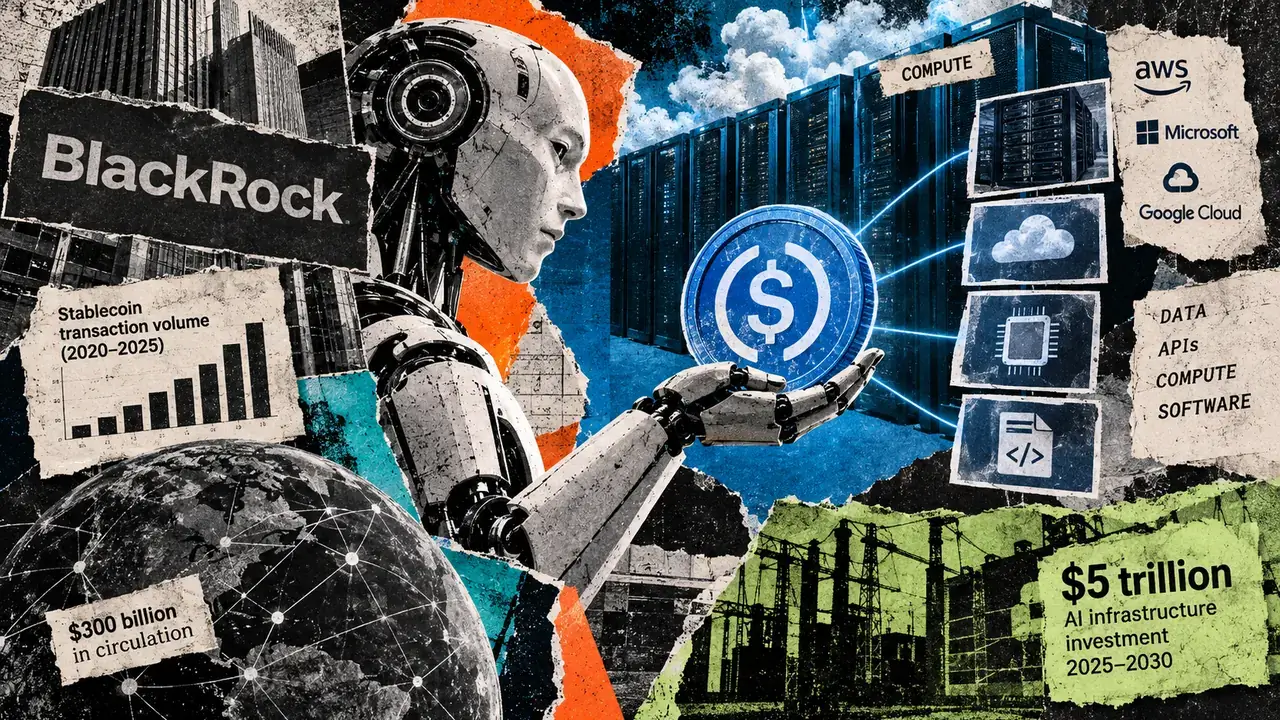
BlackRock says AI could create a new class of stablecoin customer: machines that spend continuously without human approval.
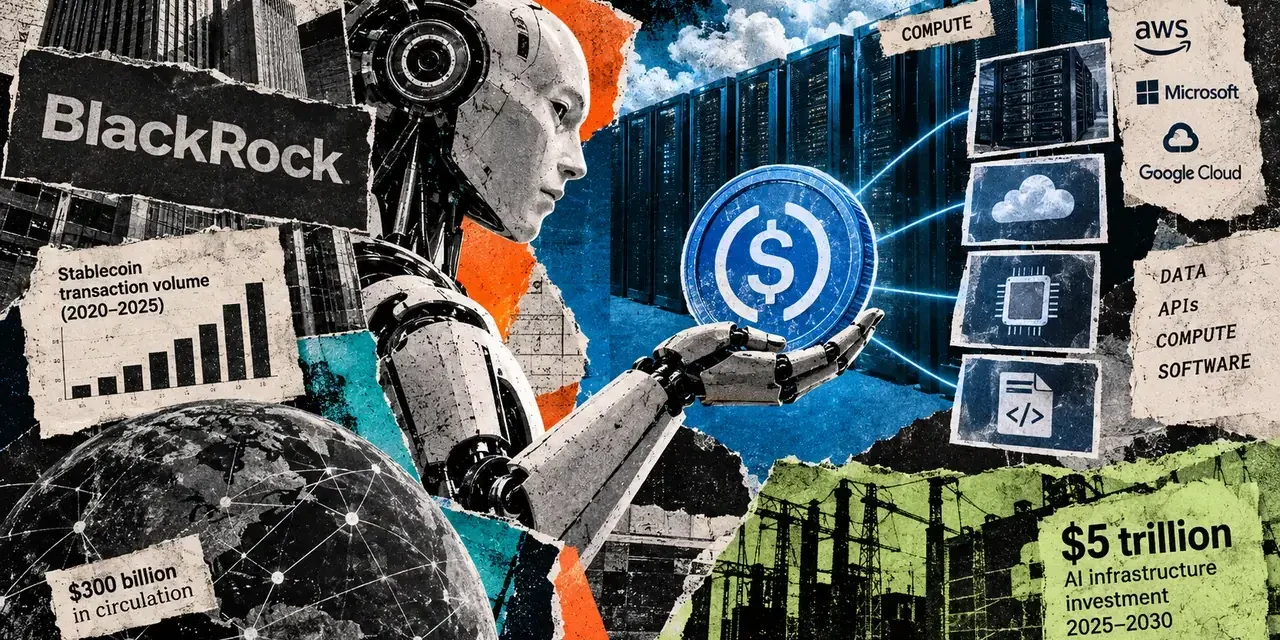
The world’s largest asset manager sees increasingly autonomous AI systems purchasing data, accessing software, and acquiring computing resources on their own, potentially adding a new source of transaction demand to digital assets beyond trading and human payments.
That prospect sits at the center of BlackRock’s new report, The Machine-Native Economy, which argues that artificial intelligence could eventually change who initiates economic activity. Instead of people making individual payment decisions, software could execute thousands of small transactions to complete a task.
Stablecoins enter that market with more than $300 billion already in circulation and about $11.2 trillion of adjusted transaction volume in 2025, according to BlackRock. The firm calculated that volume grew at an 80% compound annual rate between 2020 and 2025, compared with roughly 8.5% for the US Automated Clearing House (ACH) network.
ACH still processed about $93 trillion last year, reflecting how far stablecoins remain from the largest traditional payment rails. BlackRock also cautioned against directly comparing stablecoin activity with Visa and Mastercard because the networks measure transactions differently.
The potentially bigger shift, however, is in transaction behavior rather than existing volume.
An AI agent searching for information or computing capacity could pay repeatedly for individual API calls, data feeds, or units of processing power. Those transactions may be worth fractions of a cent and occur around the clock, creating a payment pattern markedly different from card purchases or bank transfers designed primarily around human customers.
That gives stablecoins an opening because software can hold them in programmable wallets and settle transactions without requiring a person to approve each payment.
Stablecoins may win the machine wallet before blockchains win the economics
Payment companies are already competing over how those transactions will move.
Coinbase’s x402 protocol uses the web’s HTTP 402 “Payment Required” status to let a service demand payment before returning data or another resource. An agent can request an API, receive payment instructions, transfer USDC, and get the service without a human completing checkout.
Stripe and Tempo are developing the Machine Payments Protocol, which can settle transactions through stablecoins or traditional payment methods. Stripe and OpenAI’s Agentic Commerce Protocol connect AI agents with existing merchant systems, while Google and Visa are working on separate standards around agent identity and authorization.
The competing approaches complicate any assumption that machine commerce will automatically migrate on-chain.
Traditional payment networks can adapt to autonomous software, particularly where agents transact with established businesses and consumers. Stablecoins appear better positioned where payments become especially small, frequent, or native to software.
That leaves a second contest over where the value from those payments eventually accrues.
If agents generate more stablecoin transactions on Ethereum, greater usage could increase demand for blockspace and validator services. ETH is used in the network’s fee and staking system, providing one route through which higher transaction activity can affect the native asset.
But transaction growth and token demand do not necessarily rise together.
BlackRock said the amount captured by native crypto assets will depend on fee structures, staking economics and gas-sponsorship models. Networks can process large volumes while charging very little, while applications can also shield users and agents from holding the underlying gas token themselves.
Circle’s Arc presents a different model. The payments-focused blockchain uses USDC as its native gas asset, meaning additional activity could strengthen the stablecoin’s role without producing the same transmission mechanism to a separate native token such as ETH.
For investors, that distinction could matter more if machine payments scale. Stablecoin issuers may gain transaction demand while the networks processing those transfers compete separately to turn higher throughput into economic value.
AI compute could make the machine customer considerably larger
BlackRock expects the same payment architecture to eventually reach one of AI’s biggest expenses: computing power.
Cumulative investment in AI infrastructure could exceed $5 trillion between 2025 and 2030, while Bloomberg consensus forecasts cited by BlackRock put combined revenue from Amazon Web Services, Microsoft’s Intelligent Cloud business and Google Cloud at about $1.1 trillion by 2030.
That would create a large resource market for increasingly autonomous agents to navigate.
An agent could compare computing providers by price, hardware, location, latency, or performance; purchase capacity for a specific task; and settle the cost automatically. Payments could occur per job, per use, or potentially per model token.
AI inference would then become a recurring machine-to-machine transaction loop: software finding compute, buying it, consuming it, and paying for the resource without a person intervening at each stage.
BlackRock sees an even larger financial market potentially forming around that activity.
Standardized claims on computing capacity could eventually be traded or pledged as collateral, while futures markets could allow buyers and sellers to hedge changes in compute costs. Such markets would require standards that account for major differences between chips, energy prices, locations, and performance.
That part of the thesis remains largely prospective. Agentic payment activity is still nascent, and traditional financial companies are building their own infrastructure for autonomous commerce alongside crypto firms.
The nearer competition is over the machine’s wallet.
Stablecoin issuers need their tokens to become the default settlement asset for software. Payment protocols need to become the standard agents use to request and pay for resources. Ethereum and rival blockchains face the harder task of ensuring that higher stablecoin throughput translates into demand for their own economic assets.
Traditional payment networks, meanwhile, have an incentive to keep that activity on existing rails.
As AI systems gain more authority to spend, those competing infrastructures will increasingly fight over a customer that never sleeps, can transact thousands of times in the background, and may care more about price, settlement speed, and programmability than which financial network sits underneath the payment.
and preserved the original HTML heading tags, sub headings, and key points are used as reference for rewriting a new post. The new written content should be unique and seamlessly integrate into a WordPress platform