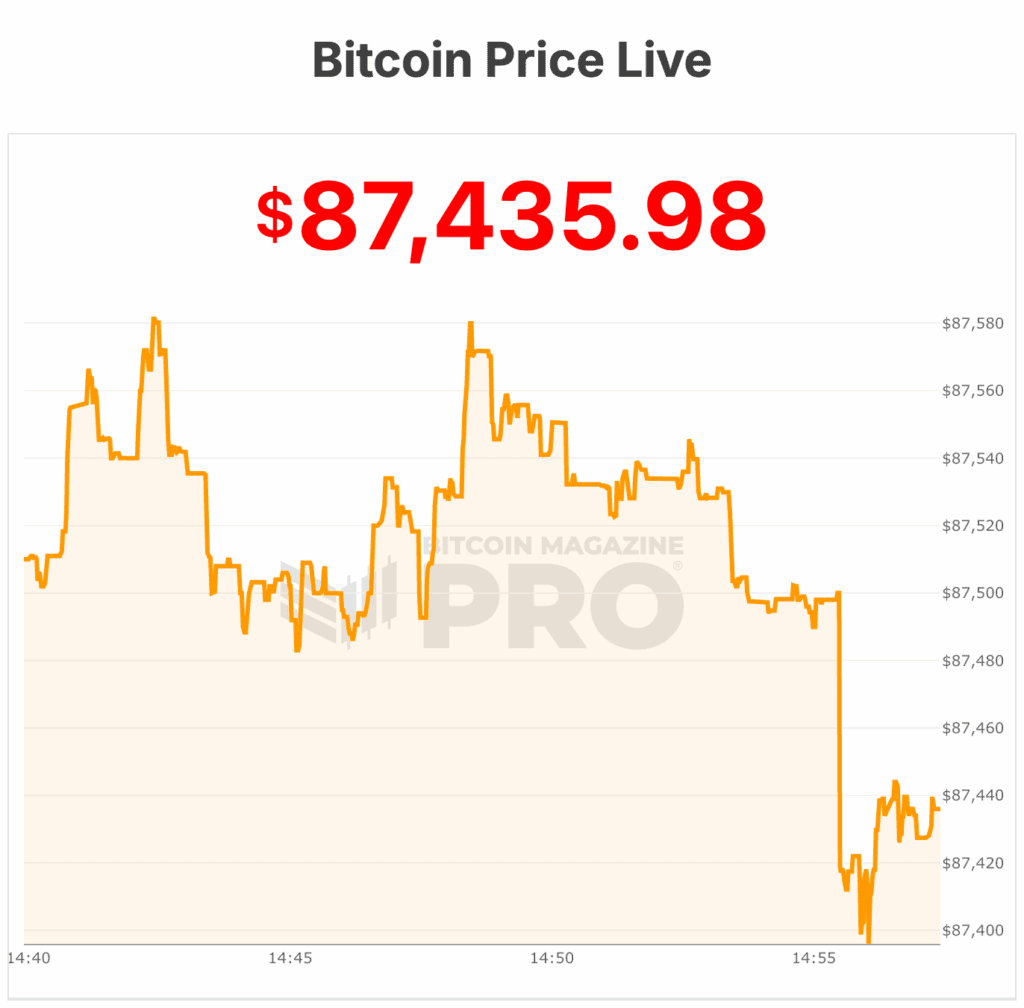

As 2025 draws to a close, Bitcoin finds itself hovering around the $87,000 mark, reflecting a period where market momentum has gradually waned. The final stretch of the year has been characterized by thin holiday trading volumes, leading to stagnation rather than the explosive growth many had hoped for. With a lack of significant catalysts, Bitcoin’s price movements have remained constrained within a narrow range.
At the moment, Bitcoin is trading slightly below $88,000, showing little change over the past week and a modest decrease compared to its starting point at the beginning of the year. Throughout December, the price has fluctuated between the low and high $80,000s, with multiple attempts to breach the $90,000 threshold resulting in minimal success.
This subdued end-of-year activity starkly contrasts with the optimism that permeated the market at the start of 2025. As the new year began, Bitcoin was positioned in the mid-$90,000 range, fueled by robust inflows into Bitcoin exchange-traded funds (ETFs), greater institutional involvement, and expectations of a more accommodating monetary policy benefiting risk assets.
Initially, these bullish narratives appeared compelling.
Bitcoin staged a remarkable rally during the first half of the year, driven by increasing ETF demand and ongoing accumulation from corporate treasuries and long-term investors. This ascent peaked in October, when Bitcoin briefly reached a staggering all-time high exceeding $125,000, thanks to a positive macroeconomic outlook, strategic positioning ahead of anticipated rate cuts, and revitalized speculative interest in derivatives markets.
However, this rally proved to be fleeting. As the fourth quarter unfolded, escalating financial constraints, rising bond yields, and a strengthening dollar began to undermine risk appetite. Consequently, Bitcoin’s price fell in tandem with equities and other growth-oriented assets, retracing a significant portion of its earlier gains.
By early December, Bitcoin’s valuation had plummeted over 30% from its peak, reverting to a trading range that defined much of the year’s price action.
Ongoing Macroeconomic Pressures on Bitcoin
The performance of Bitcoin through 2025 has been heavily influenced by macroeconomic factors. Persistent inflation led many investors to reassess their expectations, compelling central banks to adopt a more hawkish stance than originally anticipated. This environment favored cash and yield-generating assets over speculative investments, thereby constraining upside opportunities across the cryptocurrency markets. Although Bitcoin was often touted as a hedge against monetary debasement, it struggled to draw in new investors as real yields remained high.
Liquidity conditions worsened as the year drew to a close. December saw a significant reduction in trading volumes as market participants scaled back for the holidays. The resulting environment, marked by fewer active buyers and sellers, led to erratic price movements and diminished trading conviction. Additionally, the slowdown in ETF inflows during the year’s last weeks further fueled the atmosphere of caution.
On-chain metrics showcased a similar trend. Long-term holders largely remained inactive, while short-term traders controlled much of the trading volume, contributing to a consolidation phase rather than establishing a definitive trend. Large holders reduced their aggressive accumulation post-October peak, while retail participation showed a slight uptick during price pullbacks, reinforcing a consolidation mentality.
Despite these challenges, 2025 was not devoid of structural advancements for Bitcoin. The market continued its maturation process, evident through enhanced derivatives liquidity, improved custody solutions, and greater integration with traditional financial frameworks.
Spot Bitcoin ETFs concluded the year with significant assets under management, totaling tens of billions, which established new long-term demand. Although short-term flows were volatile, Bitcoin upheld its status as the leading digital asset, significantly outpacing most alternative cryptocurrencies.
While its performance lagged behind gold during periods of macroeconomic stress, Bitcoin maintained its reputation as one of the most liquid and actively traded assets globally, solidifying its role as the benchmark for the broader cryptocurrency market.
As we move into 2026, the attention turns toward the potential for a resolution to the current consolidation phase. Traders are keeping a close eye on the $90,000 level, which presents a crucial psychological and technical hurdle, while the low $80,000s have so far acted as a solid support base. A significant shift in macroeconomic conditions, renewed inflows into ETFs, or a resurgence in institutional buying could trigger the breakout needed to overcome the prevailing stagnation.
For the time being, Bitcoin enters the new year cautiously positioned around $87,000, actively seeking direction.