

The cryptocurrency market is currently witnessing a severe downturn, reminiscent of a bloodbath. Bitcoin has significantly faltered, slipping below the critical psychological barrier of $100K. While many anticipated a cascading effect that would pull altcoins down, some have shown surprising resilience. Ethereum, the second-largest cryptocurrency, is currently attempting to defend the $3,000 support level. However, the looming question is: how much longer can it sustain this position? As Bitcoin continues its slide, the situation raises concerns about the possibility of Ethereum testing the formidable support at $2,900.
Can the ETH Price Defend the Support at $3,000?
Ethereum is managing to stay above the $3,000 mark, reflecting a level of stability despite the turbulent market conditions. An analysis of the daily charts indicates a tightening price structure, as Ethereum has systematically formed higher lows over the past week while frequently testing the $3,050 to $3,100 resistance zone. This region has become a significant support range worth monitoring. On the upside, the price has been capped below $3,250, where there has been consistent selling pressure absorbing every attempt for an upward breakout.
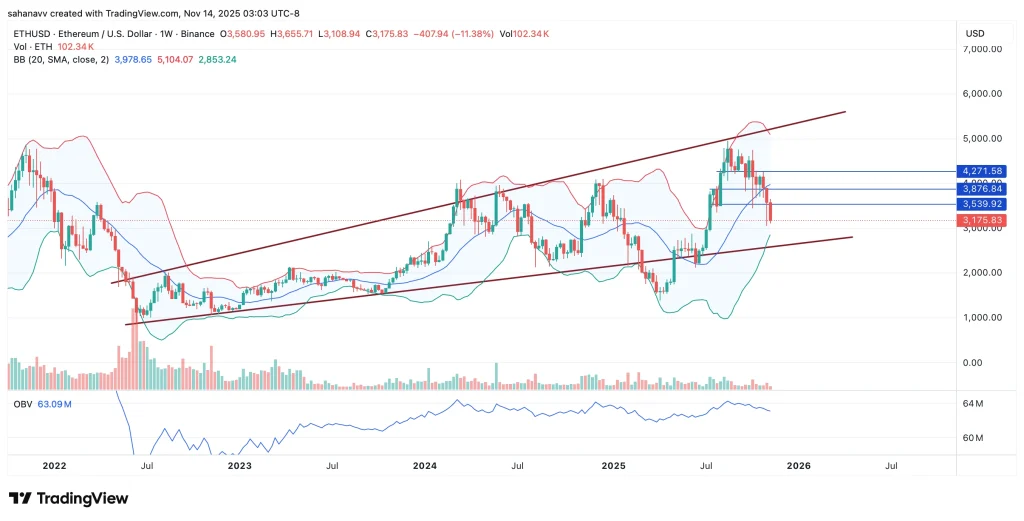
Currently trading near $3,175, Ethereum is on a crucial weekly support line within its long-term ascending channel. The tightening of the Bollinger Bands suggests a potential volatility squeeze that typically precedes a significant price movement. Furthermore, the declining On-Balance Volume (OBV) indicates weakening buying momentum, heightening the risk of a bearish breakdown. If Ethereum were to rebound, potential upside targets would be set at $3,540, $3,876, and $4,271. Conversely, failure to maintain the current support might see a drop towards $2,850, which sits at the lower boundary of the trendline support.
- Also Read:
- How Low Could Bitcoin Prices Tumble? Analysts Identify Two Crucial Levels
The Ethereum price’s ability to remain above $3,000 continues to support its medium-term bullish structure, even amid broader market volatility. The weekly chart indicates that ETH is clinging to a critical support area, and it is predicted that upcoming price movements will likely be heavily influenced by volatility surrounding major technical levels. If buyers maintain their pressure, a rebound to $3,540 and $3,876 seems plausible, while a drop below $3,175 could shift the momentum towards a decisive bearish trend. It is imperative for ETH traders to remain vigilant in light of Bitcoin’s ongoing instability.
Frequently Asked Questions (FAQs)
Ethereum’s price has been adversely impacted due to declining Bitcoin prices, decreasing buying pressure, and overall market volatility which is testing its key support levels.
Yes, if selling pressure persists or Bitcoin continues to decline, Ethereum may retest the $2,900 to $2,850 range, which is its next major support zone.
Narrowing volatility bands indicate a potential squeeze, suggesting that Ethereum is likely preparing for a substantial price movement that could establish the next significant trend.
Trust with CoinPedia:
CoinPedia has been delivering accurate and timely cryptocurrency and blockchain news since 2017. Our content is crafted by an expert team of analysts and journalists who adhere to strict editorial guidelines based on E-E-A-T (Experience, Expertise, Authoritativeness, Trustworthiness). Each article is meticulously fact-checked against credible sources to ensure accuracy, transparency, and reliability. Our review policy guarantees impartial evaluations when recommending exchanges, platforms, or tools. We are committed to providing timely updates on all things crypto and blockchain, from startups to industry leaders.
Investment Disclaimer:
All opinions and insights shared reflect the author’s perspective on current market conditions. We advise conducting your own research before making any investment decisions. Neither the author nor the publication can be held liable for any financial decisions made.
Sponsored and Advertisements:
Sponsored content and affiliate links may be present on our site. Advertised content is clearly labeled, and our editorial content remains fully independent from our advertising partners.