
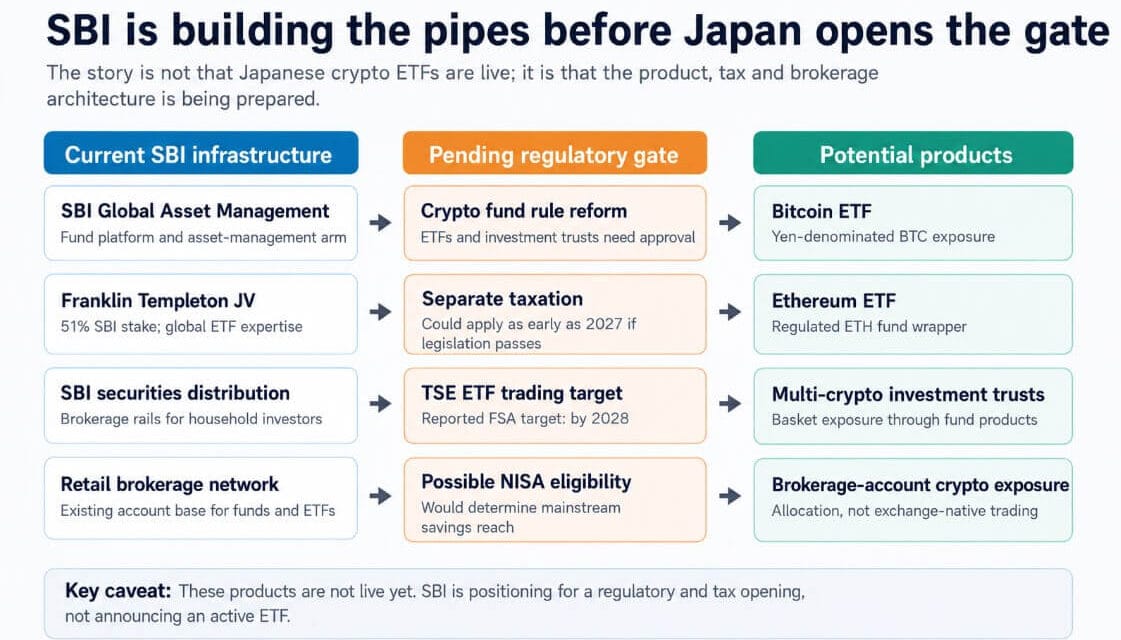
SBI Group has officially announced that its asset management division intends to roll out Exchange-Traded Funds (ETFs) focused on Bitcoin and Ethereum, in addition to establishing investment trusts that will hold diverse baskets of cryptocurrencies. This initiative is contingent on upcoming reforms in Japan regarding cryptocurrency funds and taxation policies.
In preparation for this venture, SBI has collaborated with Franklin Templeton to construct the necessary infrastructure, developed specific product categories, and set an ambitious asset under management (AUM) target of $31.5 billion within three years post-launch.
As of March 2026, the AUM of SBI Global Asset Management Group surpassed $75.5 billion, with SBI holding a 51% interest in the joint venture with Franklin Templeton and overseeing a broader securities business that boasts an AUM exceeding $415 billion.
The planned crypto ETFs are poised to leverage SBI’s extensive distribution network, which already directs millions of Japanese households toward equities, bonds, and mutual funds.
Reports indicate that the Financial Services Agency (FSA) aims to enable crypto ETF trading on the Tokyo Stock Exchange by 2028, with separate tax regulations potentially taking effect as early as 2027, contingent on the passage of relevant legislation.
Importance of Bitcoin ETF Demand in Japan
According to data from the Bank of Japan, Japanese households maintained $14.8 trillion in financial assets by the end of 2025, with 48.5% of those assets comprised of cash and deposits.
The Japanese government has long been promoting investment among households. By the end of 2025, tax-advantaged investment accounts known as NISA saw user numbers reach 28.26 million, with total purchases amounting to $447 billion.
To achieve SBI’s target of $31.5 billion in AUM, a modest allocation of only 0.21% of total household financial assets would be necessary.
Currently, there are approximately 14 million crypto accounts in Japan, nearly half the number of NISA accounts, with total customer assets exceeding $31.5 billion.
Chainalysis reports indicate a 120% increase in Japan’s on-chain value received over the year leading up to June 2025, marking the highest growth rate among major markets in the Asia-Pacific region. An ETF wrapper would channel this existing demand through established brokerage and securities platforms where Japanese savings have traditionally been invested.
In a significant regional move, Hong Kong launched Asia’s first spot Bitcoin and Ethereum ETFs in April 2024, setting a precedent.
Japan is strategically positioned to make its entry with substantial domestic savings, a well-entrenched retail brokerage culture, and major financial institutions that effectively manage everyday investment behavior for millions of households.
The approval of a spot Bitcoin ETF in the US in January 2024 has facilitated Bitcoin’s entry onto Wall Street, allowing it access to institutional balance sheets and registered investment advisers. A Japanese version would open Bitcoin trading avenues for yen-denominated brokerage accounts, conservative household portfolios, and a tax-favored investment framework that already moves millions of ordinary investors toward various equity and bond fund investments.
While the US ETF flows became the dominant regulated demand window, Japanese ETFs could create an additional yen-denominated, Asia-hours flow channel, accompanied by its own institutional buyers, custody providers, and brokerage incentives.

Necessary Pre-conditions for Implementation
Proposed legislative changes could reduce Japan’s current taxation rate on crypto gains from 55% to a more favorable 20%, aligning it with the taxation structure applied to stock trades.
SBI’s documentation from May 2026 suggests that if legislation is approved, this reduced tax rate could come into play as soon as 2027, thereby opening up the possibility for a regulated ETF to serve as a portfolio product.
Additionally, these financial products require regulatory sanctioning for ETF and investment trust structural frameworks, custody setups, market-maker depth, and decisions on whether crypto funds can qualify for NISA-style tax-advantaged accounts. This last determination may significantly influence whether crypto exposures reach households currently engaged in purchasing domestic and foreign equity index funds under their NISA allocations.
Regulatory Progress or Delay?
In a positive scenario, crypto funds gain 20% tax treatment, receive approval for ETF and investment trust structures, and gain eligibility for distribution through mainstream brokerage accounts by 2027. This could enable SBI and Rakuten to introduce products within their jointly developed distribution networks.
Achieving the $31.5 billion AUM target within a three-year timeframe would utilize assets from the existing 14 million crypto account holders as well as investors who may not typically open a dedicated crypto exchange account.
Japan would join Hong Kong in becoming a regulated source of ETF flow during Asian market hours, broadening the demand base for Bitcoin into a second major currency and time zone.
Chainalysis’ noted 120% growth already signals a burgeoning domestic appetite, and the ETF wrapper could mainstream such demand through securities frameworks into traditional portfolio allocations.
Conversely, if regulatory frameworks for ETFs and investment trusts extend beyond 2028, and tax reforms could potentially exclude crypto funds from NISA structures, the resulting high-risk classification might restrict distribution channels. In this bear case, the anticipated AUM could fall to between $3.1 billion and $12.6 billion, primarily drawing from existing crypto-native users transitioning to a regulated investment wrapper.
| Scenario | Necessary Developments | Three-Year AUM Projection | Market Implications |
|---|---|---|---|
| Optimistic Scenario: Open Savings Access | 20% tax treatment, regulatory approval for ETF/trust products, mainstream brokerage accessibility, NISA-style eligibility | ~$31.5B+ | Japan becomes a significant regulated flow channel for Bitcoin trading during Asian hours |
| Pessimistic Scenario: Regulatory Hold-ups | Delays in ETF regulations, crypto funds barred from NISA, high-risk categorization limits distribution options | ~$3.1B–$12.6B | Products service primarily existing crypto-native clients, leaving Hong Kong and offshore platforms as the central venues |
SBI has laid the groundwork for product architecture in anticipation of forthcoming regulatory openings in Japan. The potential investors possessing substantial capital to flow into Bitcoin exposure might include those currently holding $7.2 trillion in cash deposits and utilizing NISA accounts for index fund investments.
An ETF wrapper coupled with favorable tax treatment and effective distribution through brokerage channels would create a familiar investment pathway for these individuals, and that is precisely what SBI is currently working to establish.
The initiative outlines a promising future for Japan’s entry into the global cryptocurrency landscape, poised for transformative changes in how the Japanese public engages with digital assets.
The post Japan’s Strategy for Bitcoin ETF Launch: Paving the Way for Household Investments appeared first on CryptoSlate.