
As the deadline for legislative action on the CLARITY Act draws near, the prospects of securing a signing by July 4 have diminished. Both lawmakers and industry stakeholders are now shifting their focus to the upcoming August recess as a more pragmatic timeline.
Summary
- The realistic expectation among lawmakers and industry members is now centered on August as a target for advancing the CLARITY Act.
- Ongoing negotiations regarding ethics provisions and procedural hurdles in the Senate are impeding progress.
- Industry giants like Coinbase and Ripple continue to express their support, indicating that momentum for the legislation is still alive.
As reported by Crypto In America, a growing number of policymakers and industry insiders now see August as the more achievable deadline for the Digital Asset Market Clarity Act. This shift in perspective comes despite previous backing from the White House, which had aimed for a July 4 signing as a symbolic gesture coinciding with the nation’s Independence Day celebrations.
At Consensus Miami earlier this year, Patrick Witt, Executive Director of the White House Crypto Council, highlighted the administration’s aims for a July 4 passage, envisioning the act as a fitting tribute to the upcoming 250th anniversary of the United States.
Witt’s optimism was echoed in his comments to crypto journalist Eleanor Terrett, where he emphasized ongoing efforts to resolve specific language in the Agriculture Committee, negotiate ethics provisions with Democratic colleagues, and address law enforcement concerns regarding measures against illicit finance.
However, navigating the legislative process remains a challenge. As highlighted by Terrett, the Senate still needs to merge distinct versions emerging from both the Banking and Agriculture Committees, secure a requisite 60 votes to initiate debate, manage further cloture votes on amendments, and ultimately send a finalized bill to the House for any amendments.
Limited Senate Calendar Complicates July Target
Timing has emerged as one of the most significant hurdles for the bill’s advancement.
“Even if all of those outstanding issues were resolved this week, there simply isn’t enough time left on the legislative calendar to make a July 4 signing logistically possible,” Terrett noted on Monday.
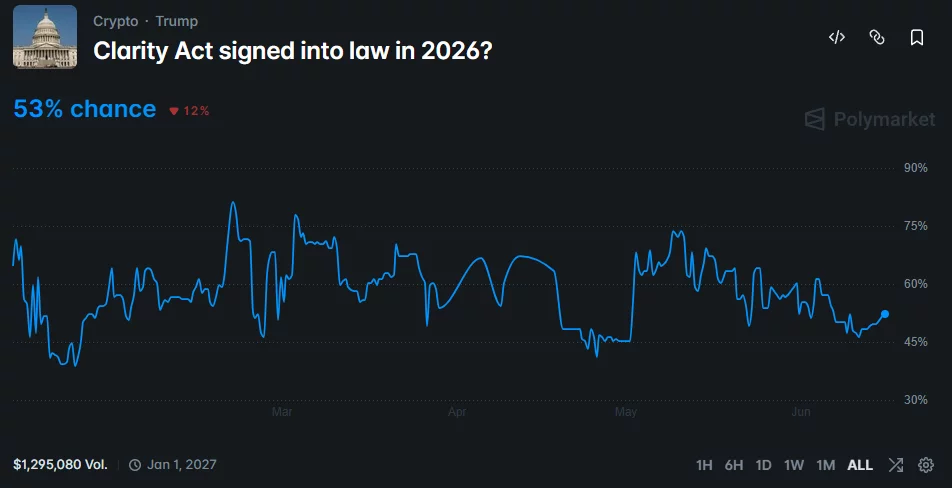
Current predictions from Polymarket indicate that the likelihood of the CLARITY Act becoming law in 2026 has dropped to 53%, a decline from approximately 75% in May.
The legislative process has been further complicated by unfinished negotiations. Reports indicate that discussions over the ethics provisions sought by congressional Democrats have proven particularly challenging, while key policy debates among lawmakers continue.
Senator Cynthia Lummis from Wyoming, one of the primary architects of the bill, previously noted that merging proposals from various committees, negotiating the ethics language, and aligning it with the GENIUS Act could take much longer than the anticipated July 4 deadline allows.
Nevertheless, the legislation has witnessed notable progress. The Senate Banking Committee advanced the bill, garnering bipartisan support, although some Democratic members have conditioned their support on the incorporation of stronger ethics safeguards linked to former President Donald Trump.
Industry Support Remains Strong Despite Delays
The CLARITY Act stands as one of the most significant proposals regarding cryptocurrency market structure currently under consideration in Congress. The initiative aims to clarify jurisdictional boundaries for digital assets, placing decentralized cryptocurrencies like Bitcoin and Ethereum under the purview of the Commodity Futures Trading Commission, while designating qualifying securities for securities regulators.
Beyond market classifications, the bill encompasses provisions on stablecoins, anti-money laundering compliance, decentralized finance activities, and blockchain validators. Recently, over 200 crypto organizations, including major players like Coinbase and Ripple, have urged Congress to expedite the passage of this legislation.
Additionally, lawmakers are grappling with competing legislative priorities that could impact the bill’s timeline. These include a bipartisan housing package, the nomination of former SEC Chair Jay Clayton as Director of National Intelligence, and the reauthorization of FISA Section 702.
Despite the delays, there remains optimism that the bill holds enough support to continue progressing. Adam Minehardt from the Hyperliquid Policy Center expressed confidence that the significant political capital already committed to the CLARITY Act ensures it will remain a key item on the congressional agenda, even if the July 4 ambition falls short.
Disclosure: This article does not constitute investment advice. The content and materials provided here are for educational purposes only.