

preferred on

Tether, the issuer of the USDT stablecoin, has stepped in to underwrite a significant recovery initiative for Drift Protocol, a Solana-based decentralized exchange (DEX), which suffered a staggering $286 million exploit earlier this month.
The terms of the rescue package, however, come with a notable commercial stipulation that could disrupt Circle’s prominence in the USDC market on the Solana blockchain.
Under the recovery plan, Drift is required to move away from its long-time dependency on Circle Internet Financial’s USDC and switch its entire framework to Tether’s USDT.
This agreement signals a calculated move by Tether to seize market presence on Solana, which has rapidly evolved into a crucial landscape for retail payments and fast-paced decentralized finance (DeFi).
Despite USDT being the reigning champion of liquidity with a market cap of $185 billion, it has historically struggled against Circle’s USDC on the Solana network. By salvaging one of the ecosystem’s leading platforms, Tether is effectively inviting itself to the forefront of the market.

The Price of Drift’s Lifeline
The recovery framework, disclosed on April 16, features a $127.5 million input from Tether.
Additional unidentified stakeholders are anticipated to contribute a further $20 million to mend the fallout from the April 1 attack.
Subsequent investigations have ascribed the breach to North Korean cybercriminals who spent months infiltrating the Drift team through social engineering tactics, posing as legitimate traders at industry functions to gain developer trust.
To rectify user losses, Drift will introduce a specialized “recovery token.” Unlike the protocol’s DRIFT governance asset, these tokens will represent a direct claim on a $295 million reimbursement pool.
These tokens will be transferable, granting victims immediate access to liquidity rather than enduring a drawn-out multi-year recovery process.
However, the most consequential change involves the mandated “USDT-first” structure.
Drift’s entire settlement mechanism, the backbone that clears and settles trades, will transition from USDC to USDT. This shift will integrate over 128,000 active users and 35 ecosystem partners into Tether’s framework.
Cindy Leow, co-founder of Drift, stated:
“The collaboration is structured around a clear, revenue-driven recovery mechanism designed to prioritize users from day one through a revenue-linked credit facility, an ecosystem grant, and loans to market-makers.”
Leow further elaborated that “a significant portion of exchange revenue, coupled with committed support capital, is intended to fund a dedicated user recovery pool.”
How Tether’s USDT is Gaining Traction Over Circle’s USDC
Some analysts are interpreting Drift’s shift to USDT as a veiled but pointed rebuke of Circle’s management of the exploit.
In the immediate aftermath of the April 1 hack, several blockchain investigators criticized Circle for its slow response in freezing the stolen assets.
In response, Circle defended its position, asserting that USDC can only be frozen when formally requested by the appropriate authorities and arguing that “the power to freeze is not the power to police.”
Circle also emphasized that unilateral intervention conflicts with due process and property rights while expressing readiness to support accountability efforts within legal boundaries.
This response, while legally sound, exposed a potential commercial vulnerability. During times of crisis, users and protocols are often more likely to favor the entity that acts swiftly to secure funds rather than the one presenting the most rigorous legal justification.
This stance contrasts sharply with Tether’s approach, which has positioned itself as a more proactive “policeman” on its platform, frequently freezing assets at law enforcement requests or following major security breaches.
“Tether responds more promptly in such cases,” remarked DeFi analyst Ignas. “I once preferred USDC due to its perceived safety. However, USDC saw a significant depeg during the banking crisis while Circle hesitated to freeze the hacked funds. Tether is strategically portraying itself as the more secure choice for retail users seeking protection.”
This sentiment was echoed by Lorenzo Romagnoli, co-founder of the USDT0 bridge protocol, which reportedly froze its Solana bridge within 29 minutes of the Drift exploit. He mentioned:
“Users gravitate towards solutions that offer protection during challenging times.”
The Battle for Solana’s Payment Infrastructure
Tether’s assertive move comes at a moment when Solana’s significance on the global financial landscape is nearing a critical threshold.
In February 2026, Grayscale reported that stablecoin transaction volume on Solana surged to an all-time high of $650 billion, buoyed by its low transaction fees and robust throughput.
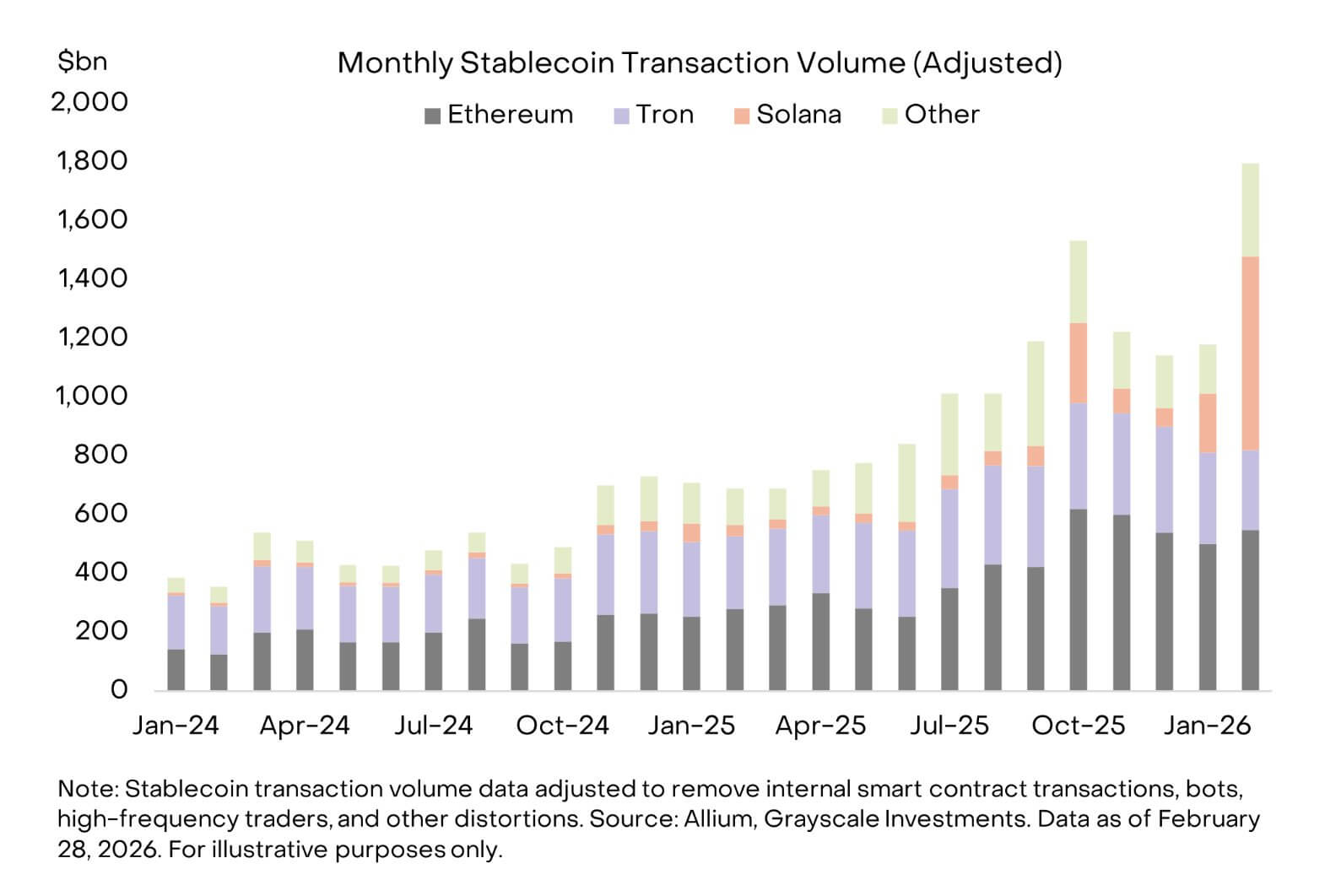
For a considerable period, Circle’s USDC has been referred to as the “Goldilocks” asset for Solana users, currently boasting a supply of over $8.1 billion, which accounts for more than 52% of the network’s total $15.5 billion stablecoin supply. Notably, USDC’s supply is nearly three times that of Tether’s $3 billion stake in the network.
This dominance has been fueled by various partnerships with traditional finance giants like Visa, PayPal, Stripe, Western Union, and Fiserv, which operate on the network.
However, the tides may be shifting.
Recent data from Blockworks Research reveals that USDC’s market share on Solana has fallen from a peak of 80% to approximately 55% as of early 2026, while USDT’s share has increased to 21%.
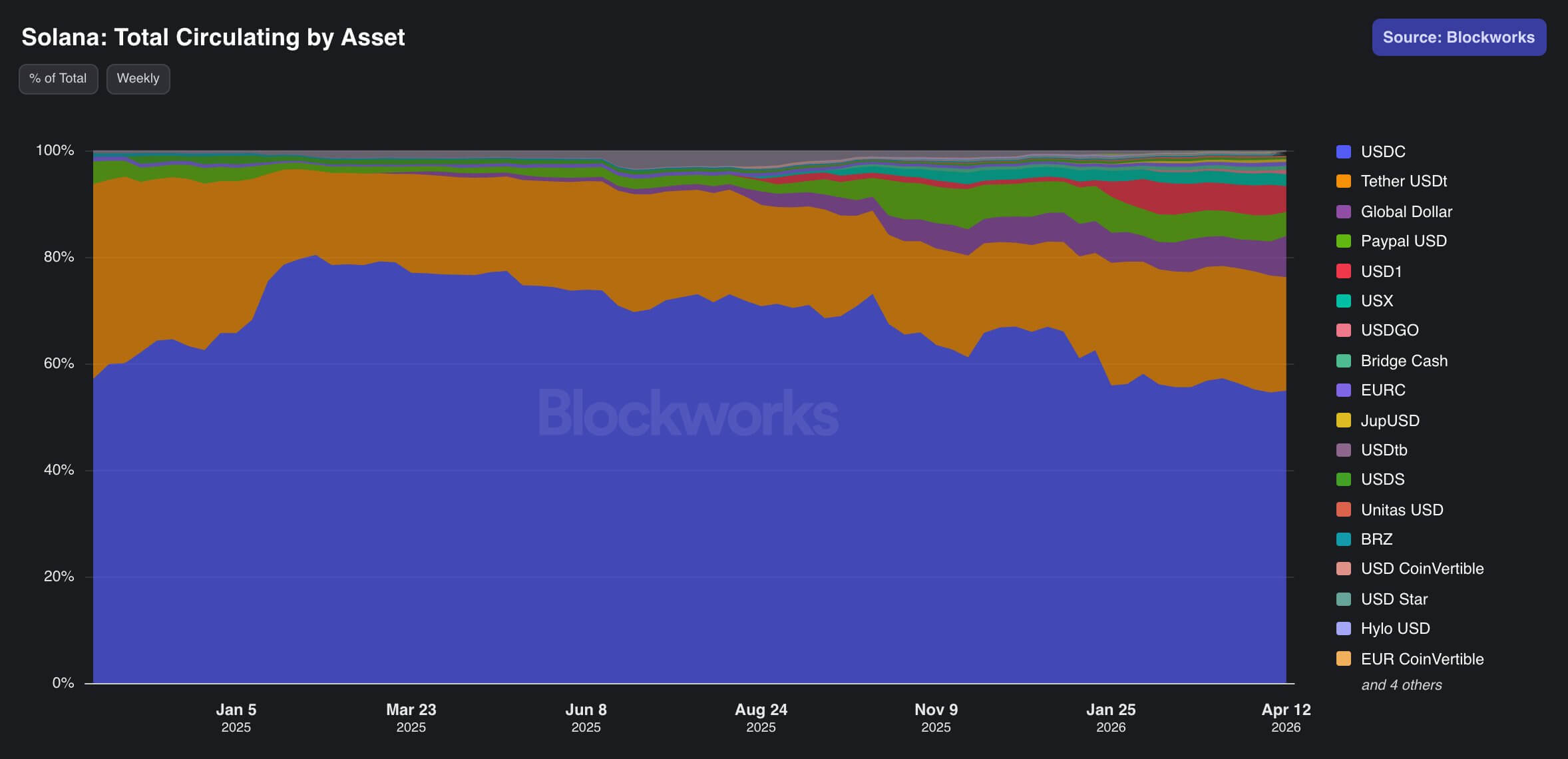
Market participants speculate that Tether’s strategy to reinstate Drift could be an attempt to expedite this market shift and capitalize on the lucrative fees associated with rapid retail transactions.
Truda, an independent crypto analyst, shared a thought:
“Consider the broader implications. By spending $100 million to save Drift, every other protocol on Solana may start viewing USDT as having an ‘unspoken bailout mechanism.’ This is a move towards market dominance.”
A New Era of Transparency?
Concurrent with Tether’s expansion onto Solana’s payment infrastructure is a robust effort for institutional credibility.
Previously regarded with skepticism within US regulatory circles, the company is now striving to improve its transparency.
Tether has reportedly engaged KPMG for an in-depth audit of its $185 billion reserves, transitioning from the attestations previously utilized for transparency.
This shift is partly motivated by the GENIUS Act, a significant US legislative move mandating stricter transparency standards for stablecoin issuers. Alongside this evolution, Tether recently introduced “USAT,” a specialized token that complies with the new American framework.
These initiatives coincide with reports suggesting Tether is eyeing a monumental $20 billion fundraising round, which would value the El Salvador-based firm at $500 billion.
However, some investors remain cautious, referencing the historical complexities stemming from Tether’s $18.5 million settlement with the New York Attorney General in 2021, as well as ongoing concerns regarding the use of USDT in illicit financing.
Nevertheless, these advancements would enable Tether to more directly compete against the regulatory advantages that Circle has traditionally leveraged for its USDC stablecoin.
As Drift gears up for its relaunch following audits by security firms OtterSec and Asymmetric, the cryptocurrency sphere is paying close attention.
The “Drift Bailout” represents more than just a recovery strategy; it symbolizes Tether’s ambition to evolve from being merely a reserve currency for offshore exchanges to becoming a fundamental player in the future landscape of retail payments, willing to invest hundreds of millions to secure its position.