Write a new detailed article from
Polkadot is a blockchain network designed to connect different blockchains so they can communicate and share data with each other. Instead of operating separately like most cryptocurrencies, Polkadot allows multiple specialized blockchains to work together through one shared system.
Polkadot remains one of the most technically advanced blockchain ecosystems in crypto, yet many investors still overlook it because newer chains dominate headlines and social media hype cycles. If you have been holding DOT and wondering why a project with strong fundamentals continues to lag behind trendier networks, you are not alone.
Polkadot has spent the last few years quietly improving its infrastructure, scalability, and decentralization. As of 2026, the network ranks among the top blockchain ecosystems for core developer activity and recently implemented a hard supply cap of 2.1 billion DOT. It also currently holds one of the highest Nakamoto coefficients in crypto, a metric used to measure decentralization and censorship resistance.
Although Polkadot lost some retail momentum after the 2021 bull market due to its technical complexity and competition from simpler networks like Solana and Ethereum rollups, many developers still value it for its shared security, interoperability, and customizable parachain architecture.
This guide explains what Polkadot is, how it works, what Polkadot 2.0 changes are, and why many investors believe the network could be setting up for a major comeback.
What Is Polkadot?
Polkadot is a foundational network that connects different blockchains, allowing them to communicate and share security seamlessly. It solves the “silo” problem where networks like Bitcoin and Ethereum operate in isolation.
Think of Polkadot crypto as a massive international airport. The Polkadot blockchain is the airport itself, providing the runways, security checkpoints, etc. The individual blockchains, or parachains, are like different airlines. While each airline has its own specific business and planes, they all use the same shared infrastructure to fly safely. This “shared security” means a small startup chain doesn’t have to build its own army of guards from scratch; it just plugs into the main hub.
Gavin Wood and the Web3 Foundation launched the project to create a truly decentralized Web3 ecosystem. He built this so developers could focus on specific features rather than worrying about safety. This Polkadot explained approach makes the network a “Layer 0” foundation that supports thousands of custom, interconnected applications.
How Does Polkadot Work?

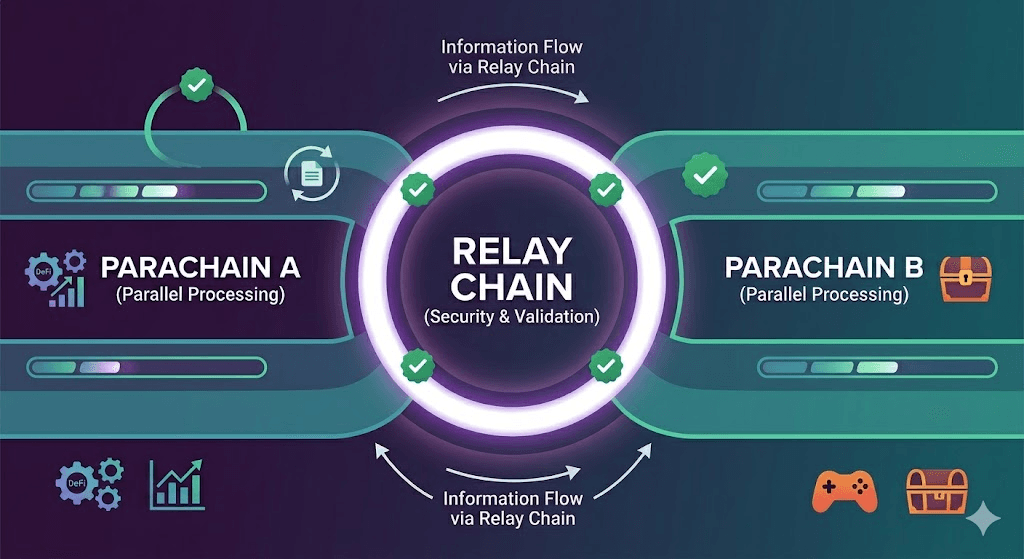
Polkadot works by connecting multiple blockchains into one shared network. Instead of forcing every app and transaction onto a single chain, the Polkadot blockchain uses a central chain called the Relay Chain and smaller connected chains called parachains.
The Relay Chain handles security, validation, and coordination for the entire network, while parachains can focus on their own specific tasks like gaming, DeFi, NFTs, or payments. Because these parachains run in parallel, Polkadot can process transactions much faster than traditional blockchains that handle everything on one chain.
One of the biggest features of Polkadot is shared security. Normally, new blockchains need to build their own validator network from scratch. On Polkadot, parachains inherit security from the Relay Chain. This system runs on Nominated Proof-of-Stake (NPoS), where DOT holders nominate validators to help secure the network.
Polkadot interoperability is powered by a messaging system called XCM (Cross-Consensus Messaging). It allows different parachains to send data, assets, and instructions to each other without needing bridges or third parties. For example, a gaming app on one parachain could send an in-game item directly to a marketplace on another chain.
This multi-chain structure is what makes Polkadot different from many other Layer 1 blockchains. Instead of competing chains operating separately, Polkadot is designed to make them work together.
Polkadot 2.0 Explained
Polkadot 2.0 is a massive upgrade that turns the network into a flexible, high-performance “supercomputer” by making resources easier to buy. The old system required projects to lock up huge amounts of money for years. Now, a new model called Agile Coretime lets developers buy computing power on the fly. It is like switching from a long, expensive apartment lease to booking an Airbnb only when you need it.
This shift makes the Polkadot blockchain much faster through asynchronous backing, which helps blocks finish twice as fast. Another feature, Elastic Scaling, allows a busy app to grab extra power during traffic spikes so it never slows down. Finally, the JAM upgrade will allow the network to run almost any type of code, not just blockchains. This ensures the Web3 ecosystem stays efficient and affordable for everyone.
Key Features of Polkadot
- Interoperability: Polkadot is built for cross-chain communication. Using XCM, different parachains can transfer data and assets between each other without relying on third-party bridges.
- Blockchain scalability: Instead of processing everything on one chain, Polkadot spreads activity across multiple parachains running in parallel. This helps the network handle more transactions efficiently.
- Shared security: Parachains connected to the Relay Chain benefit from the network’s collective security model instead of building their own validator systems from scratch.
- Forkless upgrades: The blockchain can upgrade itself without disruptive hard forks. Changes are approved through on-chain governance and implemented directly on the network.
- Customizable blockchains: Developers can build specialized blockchains for DeFi, gaming, identity, finance, and other use cases using the Substrate framework while still staying connected to the wider ecosystem.
Polkadot Use cases
The Polkadot ecosystem is a hub for specialized projects ranging from decentralized finance (DeFi) to global gaming and real-world asset tracking. Because the blockchain handles many tasks at once, it attracts high-quality apps that need speed and low fees. These ecosystem projects don’t just sit in isolation; they use the network’s “Layer 0” foundation to share security and talk to one another instantly.
Top Projects to Watch
- Moonbeam: The go-to for developers. It lets Ethereum apps run on Polkadot, making it the biggest gateway for users.
- Mythos: a massive gaming platform that moved to Polkadot to handle millions of player transactions for digital items.
- Hydration: The network’s “liquidity hub” that makes trading Polkadot crypto assets fast and cheap.
- Astar: A bridge project that helps apps work across different blockchain languages.
- Centrifuge: A leader in “Real World Assets,” bringing things like mortgages and invoices onto the blockchain.
Real-World Utility
- DeFi: Users can lend or trade assets across different chains without using risky third-party bridges.
- Gaming: Fast parachains allow thousands of players to trade NFTs without lagging the network.
- Enterprise: Companies like Energy Web use Polkadot to track renewable energy data for major European utilities.
Polkadot’s Native Token (DOT) Explained
The DOT token is what powers the Polkadot ecosystem. It is used for staking, governance, and helping new parachains join the network. In simple terms, holding DOT lets you actively participate in how the network runs.
One of the main uses of DOT is staking. Polkadot uses a system called Nominated Proof-of-Stake (NPoS), where users nominate validators to help secure the network. In return, they can earn DOT staking rewards. This system helps keep the blockchain secure while giving token holders a way to participate.
DOT also plays a big role in on-chain governance. Token holders can vote on network upgrades, treasury spending, and other major decisions. Instead of relying on a central authority, Polkadot allows the community to shape the network directly.
Another important use case is bonding. Projects that want to launch parachains need to lock up DOT tokens as part of the process. This helps filter out low-quality projects and keeps the ecosystem more secure and reliable.
Polkadot vs Ethereum: A Detailed Comparison
The choice between Polkadot and Ethereum depends on whether you value a massive, established ecosystem or a highly flexible, interconnected network. Ethereum is like a bustling, historic city where everything happens in one place, while Polkadot is a modern highway system connecting many specialized towns.
The biggest technical difference lies in how they scale. Ethereum mainly relies on rollups, which are secondary layers that process transactions off-chain and then submit compressed data back to Ethereum for security and final settlement. This reduces congestion on the main chain but still keeps Ethereum as the central execution layer.
Polkadot takes a different approach with parachains. Instead of relying on secondary layers, parachains are fully independent blockchains that run in parallel while sharing security through the Relay Chain. Each parachain can have its own rules, tokens, and optimizations, allowing the network to process multiple types of activity simultaneously rather than funneling everything through one main chain.
This means Polkadot often has lower transaction fees because it doesn’t get as congested. However, Ethereum has much higher ecosystem maturity, meaning it has more users and developers than almost any other platform.
When looking at interoperability, Polkadot has an edge because its chains are designed to “talk” to each other out of the box. On Ethereum, moving assets between different rollups can still feel clunky.
Both networks are highly decentralized, but they use different math to stay secure. Ultimately, if you want the most popular apps, Ethereum is the spot. If you want a future-proof multi-chain network where specialized blockchains rule, Polkadot is the clear winner.
Benefits and Limitations of Polkadot
Polkadot offers unmatched flexibility and security for developers, but it faces a steep learning curve and slower adoption compared to more beginner-friendly networks. It is a powerful “Layer 0” foundation that allows different blockchains to work together without middlemen. While the technical advantages are clear, its complexity can be a double-edged sword for both builders and everyday investors.
The Benefits
- Strong interoperability: The Polkadot ecosystem allows different blockchains to communicate and transfer data natively through XCM, making cross-chain applications easier to build.
- Better scalability: Because parachains run in parallel, the blockchain can process many transactions at the same time instead of bottlenecking activity onto one chain.
- Shared security: Parachains inherit security from the Relay Chain, allowing smaller projects to launch without building their own validator network from scratch.
- On-chain governance: DOT token holders can vote on upgrades, treasury spending, and network decisions, helping keep the ecosystem decentralized and community-driven.
The Limitations
- Steeper learning curve for developers: Building with the Substrate framework often requires Rust programming knowledge, which can slow developer adoption.
- Complex ecosystem: For beginners, understanding parachains, staking, governance, and interoperability can feel overwhelming compared to simpler blockchains.
- Heavy competition: It competes with Ethereum, Cosmos, Solana, and Avalanche, all of which are also trying to solve blockchain scalability and interoperability.
Is Polkadot Secure?

Polkadot is considered one of the safest networks because it uses a shared security model where every connected chain is protected by a single, massive wall of validators. Instead of each small project trying to defend itself, they all plug into the main hub for protection. This means a hacker would have to attack the entire Polkadot blockchain just to mess with one tiny app, which is nearly impossible and incredibly expensive.
This system works through a strict validator system that checks every transaction for foul play. If a validator tries to lie, they lose their staked DOT tokens through a process called slashing. While the core network is rock-solid, users should still watch out for smart contract risks on individual apps or bridge risks when moving money to other networks like Ethereum.
Is Polkadot Taxable?
Yes, Polkadot is taxable in most countries. How your DOT is taxed depends on what you do with it. If you earn DOT through staking, it is usually treated as ordinary income based on the token’s market value when you receive it. If you later sell, swap, or spend your DOT, you may also owe capital gains tax.
In countries like the US and UK, DOT staking rewards are generally taxable as soon as you gain control of them.
Selling or trading DOT creates a separate taxable event. Your gain or loss is calculated using the difference between your cost basis and the sale price. Since tracking taxes across wallets, staking, and parachains can get complicated quickly, many users rely on crypto tax softwares like Bitcoin.Tax to automate reporting and keep records accurate.
Is Polkadot a Good Investment?
Polkadot is often seen as a strong long-term bet on a multi-chain future. Its biggest strength is interoperability, allowing different blockchains to communicate and share data instead of operating in isolation. If the Web3 ecosystem continues moving toward connected, specialized chains, the blockchain could play an important role.
That said, Polkadot also faces heavy competition from Ethereum, Solana, Cosmos, and other Layer 1 networks. Its technology is powerful but more complex, which has slowed mainstream adoption at times. DOT token inflation and overall ecosystem growth are also important factors investors watch closely.
Like most crypto investments, Polkadot comes with both high potential and high risk. Its future largely depends on developer adoption, parachain growth, and whether its interoperability-focused vision gains wider traction.
Frequently Asked Questions
Is Polkadot environmentally friendly?
Yes, Polkadot is one of the greenest networks in crypto. Because it uses Nominated Proof-of-Stake (NPoS) instead of energy-hungry mining, its carbon footprint is remarkably small. According to recent reports, the entire network consumes about as much energy as 6.6 average households per year, making it far more sustainable than traditional proof-of-work systems.
Does Polkadot have a maximum supply?
As of March 2026, Polkadot shifted to a hard supply cap of 2.1 billion DOT. Previously, the network had an inflationary model with no limit. This major change was designed to create scarcity and make the token more attractive for long-term holders, effectively moving the protocol toward a “deflationary” path as it reaches that cap.
How can a beginner buy DOT?
Buying DOT is straightforward in 2026. You can use major exchanges like Coinbase, Kraken, or Bitget. After setting up an account and completing a quick identity check, you can link a bank account or debit card to purchase tokens. Once bought, you can keep them on the exchange or move them to a personal wallet like Talisman to start earning staking rewards.
The post What is Polkadot? Features, Benefits, Risks, and Future appeared first on BitcoinTaxes.
and preserved the original HTML heading tags, sub headings, and key points are used as reference for rewriting a new post. The new written content should be unique and seamlessly integrate into a WordPress platform