
Solana has surged to command 23% of the global blockchain developer market share, a significant leap from just 6% back in 2020. This represents a staggering 45% increase year-over-year in active builders—an unlikely twist that few could have predicted in 2022. This development is certainly bullish news for the Solana ecosystem.
Meanwhile, Ethereum’s share has dipped to 31%, marking a notable decline below 35% for the first time since 2022. This decline signifies a loss of nearly five decades of dominance in under four years.
The implications of this data highlight a structural shift: developer talent is consolidating around high-performance integrated chains, leading to a fundamental reset in the Layer 1 competitive landscape.
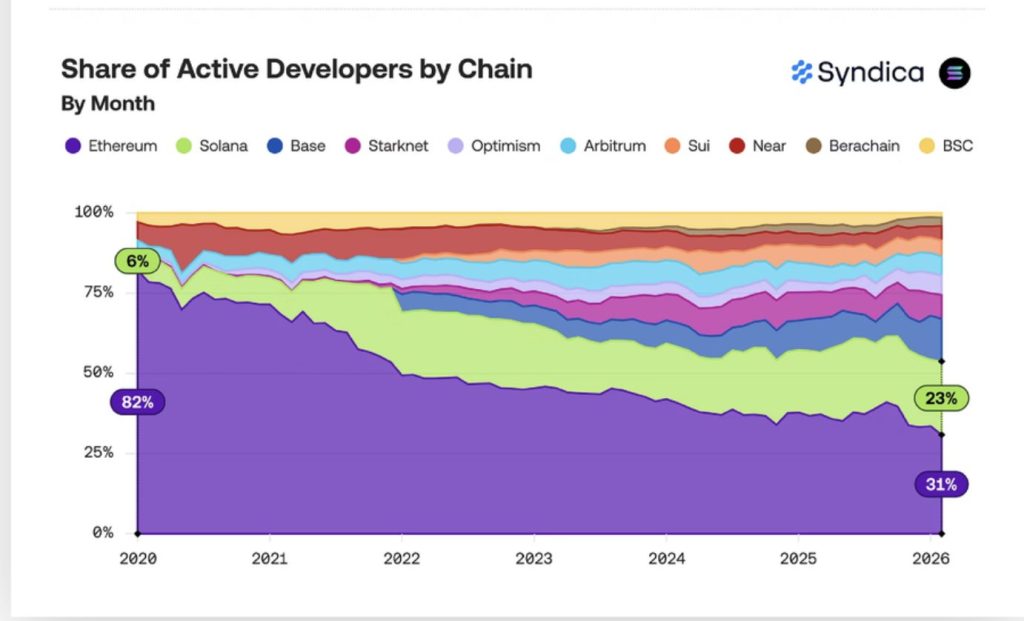
A recent report from Syndica, which tracks developer distribution across blockchain networks, confirms what has been quietly unfolding within the Ethereum ecosystem over the past two years: its once-unassailable lead in builder mindshare has evaporated.
Discover: The best crypto to diversify your portfolio with
The Developer Numbers Explained
The Electric Capital Report provides context for this shift by citing Ethereum’s 2020 baseline at 82% of all active blockchain developers. Today, that number has plummeted to 31%, indicating a 51-percentage-point collapse over six years. In contrast, Solana’s numbers have seen a remarkable uptick across various segments.
For professional developers, Solana previously constituted 5% but has now grown to 20%. In terms of hobbyist developers, Solana leads with 28% compared to Ethereum’s 24%. Notably, in 2025 alone, Solana onboarded 4,100 new developers, surpassing Ethereum’s 3,700.
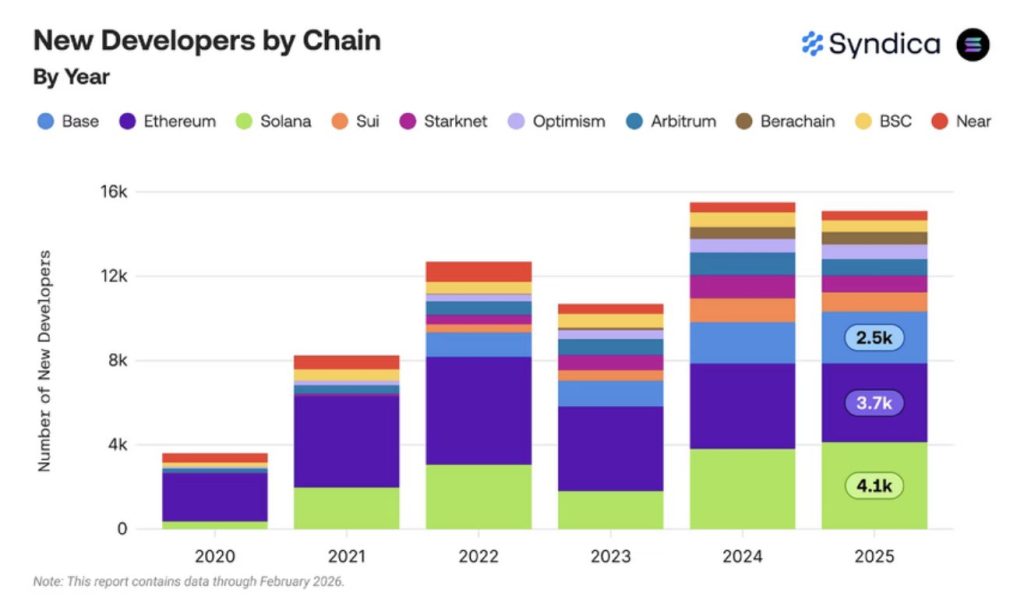
By the time Solana hit its fifth anniversary, its cumulative developer count had surpassed Ethereum’s fifth-year total by approximately 50%. This is not just a minor fluctuation; it signals a compounding trajectory that is telling.
In the realm of non-EVM networks, the comparison between SOL and ETH becomes even more pronounced. Solana holds a staggering 60% of all weekly active developers in the non-EVM category, which is more than the combined share of the next five competing chains. Base has emerged as a credible third-place contender with a 14% overall share. However, since it operates on Ethereum’s infrastructure, it contributes to the ongoing fragmentation of the Ethereum ecosystem.
The distribution of output across each network also highlights a structural difference. In Ethereum, the top 1% of developers generate a staggering 51% of the network’s total code. In contrast, Solana’s top 1% accounts for only 31%. This indicates a more evenly distributed developer base on Solana, which is particularly active over weekends, comprising 17% of all contributions, and relies less on a small group of prolific insiders to maintain momentum.
Solana: The Go-To Choice for Developers
The reasons for Solana’s rise are straightforward. In Q1 of 2026, the network processed an astounding 25.3 billion transactions—125 times Ethereum’s volume during the same timeframe. When speed and cost efficiency become primary considerations for real-world financial applications, the numbers clearly favor Solana.
Ben Nadareski, CEO and co-founder of Solstice, a DeFi protocol built on Solana, characterized the situation succinctly: “The transactions are happening on Solana. Activity moved to where the cost and speed make sense.”
Ethereum’s shift toward a rollup-centric roadmap has led to a fragmentation of the developer experience across multiple platforms including Base, Arbitrum, and Optimism, among several smaller chains. Each Layer 2 solution introduces the need for context-switching, specialized tooling, and fragmented liquidity. In contrast, Solana’s monolithic architecture keeps talent and capital concentrated in a cohesive execution environment.
This approach represents the integrated chain thesis, and the developer statistics confirm its effectiveness.
The hobbyist developer segment is not merely a bystander; it is actively contributing to a vibrant ecosystem. Nadareski noted: “The hobbyist layer ships vault wrappers, yield aggregators, leveraged loops, and UX layers around primitives like eUSX or USDC. The legos pile up.” Concurrently, institutional tooling around Solana is maturing more rapidly than it did with Ethereum five years ago, driven by a distinct and clearer institutional demand.
The recent infrastructure partnerships by the Solana Foundation are expediting this onboarding curve. It’s important to note that developer growth alone does not transform a network’s institutional posture; however, the rapidity of developer growth, coupled with custodial solutions and transaction volume leadership, certainly does.
Discover: The best pre-launch token sales
The post Solana Just Overtook Ethereum in New Developer Signups — Biggest News Shift for Solana? appeared first on Cryptonews.